
Best SEMrush Alternatives for 2026 (Free & Paid Options)
Discover the best SEMrush alternatives in 2026. Compare free and paid SEO tools like Ahrefs, Moz, and Ubersuggest to find the right fit.
 By Divyesh Savaliya
If you’ve spent any time in SEO, you’ve probably used SEMrush or at least considered it. It’s one of those tools everyone talks about. It does keyword research, competitor tracking, backlinks, site audits, PPC research, content ideas, pretty much everything.
And that’s exactly why some people start looking elsewhere.
SEMrush isn’t bad. It’s powerful. But sometimes, powerful turns into overwhelming. You log in to check one thing and end up staring at ten dashboards, five reports, and more filters than you actually need. At some point, you start asking yourself a simple question: Do I really use all of this?
For some teams, the answer is yes. For others, not even close. If you’re in that second group, this guide will help you sort through the best alternatives. Some are paid. Some are free. All of them serve a slightly different type of user.
Why People Start Looking Beyond SEMrush
Most people don’t switch tools because they’re angry. They switch because their needs change. A solo blogger doesn’t need the same setup as a 12-person agency. A startup watching every dollar doesn’t think the same way as an established ecommerce brand.
I’ve seen freelancers sign up for SEMrush, feel excited for a week, and then realize they’re only using keyword research and maybe the occasional site audit. Paying for a full suite starts to feel unnecessary.
Agencies have a different complaint. They want deeper backlink data. Or better reporting for clients. Or pricing that doesn’t climb too fast as they add projects. Then there’s the usability factor. SEMrush packs a lot into one place. That’s impressive, but it also means you have to learn it. If you prefer clean, focused tools, it can feel crowded.
When choosing an alternative, most people care about three things:
Does it give me accurate data?
Is it easy to use day-to-day?
Does the price make sense for how I work?
Best Free & Freemium SEMrush Alternatives
Not everyone needs a big, paid SEO platform. Sometimes, a couple of simple tools give you exactly what you need without the monthly bill. These options won’t replace every part of SEMrush, but they shine in specific areas and are great starting points for most people.
Ubersuggest
Best for: Bloggers, freelancers, and small websites that want simple SEO data without complexity.
Ubersuggest is one of those tools that feels friendly right away. You don’t need to be an expert to understand what the numbers mean. It gives you basic SEO metrics without clutter. It’s not as deep as a traditional paid tool, but it covers the essentials.
Features you’ll care about:
Keyword ideas and search volume
SEO difficulty and paid difficulty scores
Top-ranking pages for any keyword
Basic backlink data
Simple traffic estimates
Easy-to-read charts and trends
For someone who just wants to know what topics to write about, how hard it’ll be to rank, and who the competition is, this does the job without overthinking it.
Google Search Console
Best for: Every website owner who wants real performance data straight from Google.
Google Search Console isn’t a direct replacement for SEMrush, but if you’re tracking how your own site is doing, this is the most honest, raw data you’ll get, and it’s free.
Features you’ll care about:
Actual clicks and impressions from Google search
Average position for your pages
Queries that bring people to your site
Page-level performance
Coverage issues and site errors
Manual action alerts
People using Search Console often pair it with another lightweight tool for keyword ideas or content planning, because Search Console doesn’t give competitor info. But for watching your own site’s health and performance, nothing beats it.
AnswerThePublic
Best for: Content creators and writers who need topic ideas that real people actually search for.
This one doesn’t pretend to sell you keyword volume or competition scores. Instead, it shows what questions people are typing into search engines about your topic. That makes it perfect for coming up with blog ideas, FAQ sections, or YouTube video topics.
Features you’ll care about:
Questions people ask around a keyword
Prepositions and related phrases
Alphabetical list of related search patterns
Visual maps of search terms
Easy CSV export for idea lists
The free version lets you run a few searches per day — enough to build a solid content plan.
Google Trends
Best for: Anyone who wants to understand interest over time for topics and keywords.
Google Trends doesn’t give exact search volumes. Instead, it shows you patterns whether a topic is gaining interest, fading, or peaking seasonally.
That’s incredibly useful if you’re planning content calendars, launching products, or trying to time a campaign just right.
Features you’ll care about:
Interest over time charts
Regional popularity
Rising and related queries
Topic comparisons
Seasonal trends
Put simply, it helps you avoid writing about something that everyone cared about last year when no one cares about it today.
Best Paid SEMrush Alternatives
If SEO is a serious part of your growth plan, paid tools make life easier. Free platforms are helpful, but once you start managing multiple campaigns or clients, you need deeper data and better tracking.
These tools cost money, but they save time. And in SEO, time usually equals traffic.
Ahrefs
Best for: Teams and professionals who care deeply about backlink data and competitor research.
Ahrefs has built a reputation around its backlink index. Many SEO professionals trust it specifically for link analysis. If your strategy includes outreach, digital PR, or competitive link building, this tool gives you the clarity you need.
It also does an excellent job with keyword research. You can see search volume, difficulty, traffic potential, and even how many clicks a keyword might realistically bring. That extra layer of detail helps avoid chasing keywords that look good but bring little traffic.
Key features and capabilities:
Large backlink database with link growth tracking
Keyword research with traffic potential estimates
Content Explorer to find top-performing pages
Detailed competitor analysis
Site audit tool with technical issue breakdown
Rank tracking across countries and devices
Ahrefs feels focused. It does not try to be a marketing automation platform. It sticks to SEO and does it well.
Moz Pro
Best for: Small to mid-sized businesses that want an easier learning curve and clear reporting.
Moz Pro has been around for years, and many marketers started their SEO journey with it. It feels less intense compared to other advanced platforms. The layout is cleaner, and the reports are easier to explain to non-technical stakeholders.
One of its well-known metrics is Domain Authority, which many teams use as a quick benchmark when evaluating websites.
Key features and capabilities:
Keyword research with priority scoring
Site audits with clear explanations
On-page optimization suggestions
Domain Authority and Page Authority metrics
Competitor tracking
Custom reporting dashboards
Moz works well if you want solid data without feeling buried in technical layers.
SE Ranking
Best for: Agencies and growing teams that need reliable tracking at a more flexible price point.
SE Ranking has gained attention because it offers most of the features businesses need, but often at a lower cost than bigger platforms. It is especially strong in rank tracking.
If monitoring keyword movement is central to your work, this tool makes it simple and accurate.
Key features and capabilities:
Keyword rank tracking by location and device
Competitor keyword comparison
Backlink monitoring and history
Full website audit
White-label reporting for agencies
Marketing plan checklist feature
Many agencies appreciate the reporting flexibility, especially when handling multiple clients.
Serpstat
Best for: Startups and marketing teams looking for balanced features without premium pricing.
Serpstat covers both SEO and PPC research in one place. It may not dominate in one single category, but it performs consistently across the board.
For businesses that want keyword research, site audits, and competitor data without jumping between tools, Serpstat can be a practical choice.
Key features and capabilities:
Keyword research and clustering
Site audit with actionable recommendations
Backlink tracking
Competitor domain comparison
Rank tracking
PPC keyword analysis
It is often chosen by teams that want an all-around tool without paying top-tier subscription costs.
Majestic
Best for: Professionals who focus heavily on backlink analysis.
Majestic is not an all-in-one SEO suite. It specializes in links. If your work revolves around link quality, trust metrics, and historical backlink data, Majestic is built for that purpose.
Key features and capabilities:
Large backlink index
Trust Flow and Citation Flow metrics
Link context analysis
Historical link data
Bulk backlink checking
It is more specialized than other tools listed here, but for link-focused campaigns, it remains relevant.
Quick Comparison: Best SEMrush Alternatives
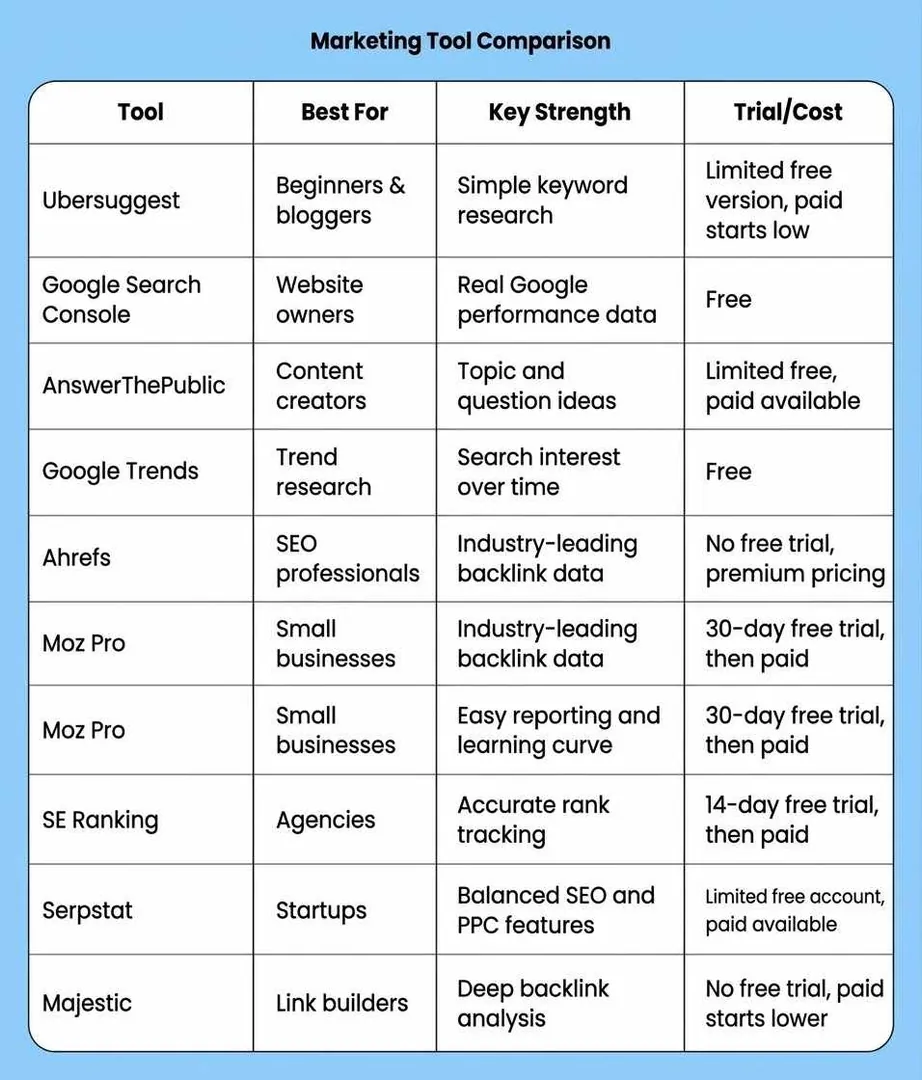
Quick Picks (If You Just Want the Best Option)
Best free tool for tracking your own site: Google Search Console
Best beginner-friendly SEO tool: Ubersuggest
Best for backlink research and competitor analysis: Ahrefs
Best affordable all-in-one SEO platform: SE Ranking
Best for finding content ideas and questions people search for: AnswerThePublic
These tools cover most SEO needs without requiring the full complexity of a large platform.
Conclusion
SEO tools are meant to simplify your work, not make it more complicated. While SEMrush is a powerful platform, many marketers discover they only need a handful of features to manage their SEO effectively.
Free tools like Google Search Console and Google Trends already provide valuable insights, and combining them with a focused SEO platform can often give you everything you need.
Instead of chasing the most advanced software, focus on the tool that helps you research better keywords, understand your audience, and consistently improve your content.